Modules and Accommodation for Vaca Muerta: What an Oil Camp Needs
How to solve staff accommodation in Vaca Muerta: housing modules, dormitories, dining halls and offices for oil & gas camps in the Neuquén basin.
Vaca Muerta does not stop. The Neuquén basin is the engine of Argentina's unconventional oil and gas, and that means thousands of people working in the field, far from the cities, who must live near the wells during their shifts. Without accommodation, there is no operation.
The challenge is significant: activity is intense, drilling pads change location, and each new project phase moves crews that need somewhere to sleep, eat and work. In this article we review what an oil camp in Vaca Muerta needs and how we solve it with modules built for the pace of the basin.
The problem: housing staff in an operation that moves
Unlike a fixed worksite, a Vaca Muerta field is dynamic. Today the activity is in one area; in a few months it shifts to another. The camp has to follow that rhythm: set up fast, expand when the headcount grows and, when needed, relocate.
On top of that comes the environment. The Neuquén steppe has permanent Patagonian wind, dust and strong temperature swings. The accommodation cannot be just anything: it must insulate well, withstand the wind and provide decent conditions so staff can rest and perform the next day.
Traditional construction in that context is slow, expensive and rigid. That is why the oil industry turned to modular solutions a long time ago.
The answer: what an oil camp needs
A well-built camp for Vaca Muerta combines several types of modules according to function:
Dormitories
The core of the camp. Housing modules —folding or expandable— configured to house shift personnel. Here insulation matters: a worker's rest depends on the module holding the temperature against the cold and heat of the steppe.
Dining halls and kitchen
An operation with dozens or hundreds of people needs to solve meals. Dining-hall modules provide the space to serve and eat, sized to the headcount.
Bathrooms and showers
Enough sanitary infrastructure for the amount of staff. It is one of the first things calculated when sizing a camp, because it defines the real capacity.
Site offices
Technical and supervisory staff need a place to work, meet and manage the operation at the field. Office modules cover that function.
The key is to size the combination well according to the number of people and the length of the phase. An oversized camp is wasted money; an undersized one, an operational problem.
Why folding and expandable modules fit Vaca Muerta
The two solutions we use most in the basin have different and complementary logics:
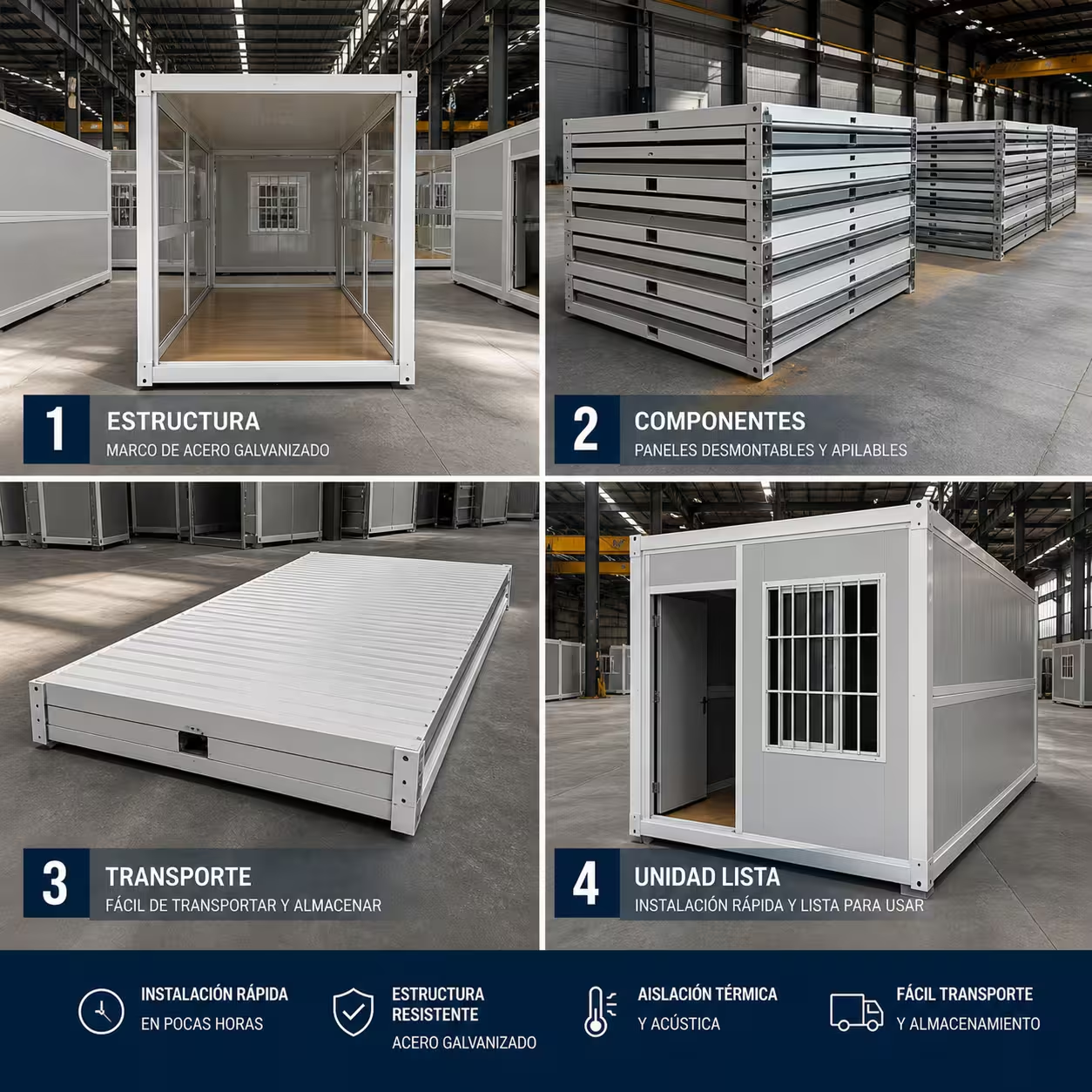
- Folding modules: they travel folded, so many fit per truck. That lowers freight cost, something key when you have to bring volume to a field. They deploy fast, with no civil works, and become operational almost the same day.
- Expandable modules: they arrive as a container and open up to a much larger surface. They yield more livable square meters per unit, ideal when interior space is the priority.
Both share what Vaca Muerta demands: they assemble fast, can be relocated when activity moves, and withstand the steppe conditions with an anchored steel structure and Class A rock-wool insulation.
How we handle it at Rutas del Sur
We reach the Neuquén basin from Mendoza via routes we know well. For a project in Vaca Muerta we offer:
- Folding and expandable modules for dormitories, plus dining halls, bathrooms and offices.
- Turnkey camps sized to the headcount and the phase of your operation.
- Coordinated logistics to Añelo and the Vaca Muerta areas, with on-site assembly.
- Direct import from the factory, which lets us tailor the proposal to your project.
You can read more on our solutions for Vaca Muerta page, or get the details on folding modules and turnkey mining camps. If you are interested in the logistics of moving supplies to the basin, also check the Mendoza–Neuquén route.
How to size accommodation by headcount
The million-dollar question when building a camp is how many modules are needed. There is no magic formula, but there is a logic worth following:
Start with the staff roster. How many people work, in which shifts and for how long. That defines the number of dormitory beds. A camp with rotating shifts can share beds between shifts ("hot bunking") and reduce modules, or assign fixed beds depending on the operation's policy.
Calculate services in proportion. Bathrooms and showers, dining hall and common areas are sized according to the number of people, not at random. A well-built camp keeps a reasonable ratio between dormitory beds and sanitary and dining capacity; if you fall short there, the camp "doesn't work" even if there are beds to spare.
Think about the project curve. An operation's headcount is not constant: the construction phase usually has a peak of people, and then it drops in operation. That is why a scalable solution is best: add modules at the peak and, if needed, relocate or remove them later. Folding and expandable modules allow exactly that.
If you want to go deeper into the calculation, we have a dedicated article on how to size a mining camp that applies almost identically to an oil camp.
Why Vaca Muerta is not the same as a high-altitude mining camp
Although the demand for accommodation is similar, there are differences that change the solution. In northern lithium mining, the main challenge is altitude (3,500-4,000 meters) and the extreme cold of the Puna. In Vaca Muerta, altitude is not the issue: the field is in the steppe, at much lower elevations. What rules here is the Patagonian wind, the dust and, above all, the speed of change of the operation.
That has a practical consequence: in Vaca Muerta, the ability to set up, expand and move the camp quickly is especially valued, because the activity shifts with the drilling pads. A module that deploys in minutes and can be relocated is worth gold in that context. Insulation is still important —the cold and wind hit— but logistical flexibility matters even more.
Understanding that difference is what lets us propose the right combination for each case, instead of applying the same recipe to every project.
Buy or rent: what works best for the project
A decision that comes up often is whether to buy the modules or solve it another way. The answer depends on the duration and predictability of the project:
- For long or recurring operations, buying the modules usually makes sense: the investment is amortized, they remain an asset and can be reused between projects or relocated within the basin. For a company that will be in Vaca Muerta for years, having its own modular infrastructure is the logical choice.
- For specific phases or work peaks, sometimes the most efficient option is a focused solution that covers exactly that window. Here the important thing is not to oversize: paying for capacity you will use for three months makes no sense.
We import directly from the factory, with no middlemen, which lets us tailor the proposal to what your project actually needs, whether a purchase for a long-term operation or a solution sized for a specific phase. We discuss it based on your case.
Timing: from the decision to an operational camp
Another concrete advantage of modular over traditional construction is time. A site camp built on location can take months between planning, materials and labor in an area where everything is expensive and far. With folding and expandable modules, the bottleneck is no longer the construction: once the configuration is defined, the timeline is mainly driven by the logistics of getting the units to the site and the assembly, measured in days or a few weeks depending on the size.
For an oil operation where every day of delay has a cost, that difference in timing is real money. Being able to go from the decision to an operational camp quickly is often as important as the cost of the module itself.
In short
A camp for Vaca Muerta needs dormitories, dining halls, bathrooms and offices, sized to the headcount and built for an operation that moves. Folding and expandable modules fit because they set up fast, relocate and withstand the steppe. The key is combining them well.
Got a project in Vaca Muerta? Quote your camp and we build a proposal tailored to your operation.