Accommodation for Lithium Projects in the Puna: Everything You Need to Know
A guide to modular accommodation for lithium projects in the Argentine Puna: altitude, cold, logistics and regulations. Salta, Jujuy and Catamarca.
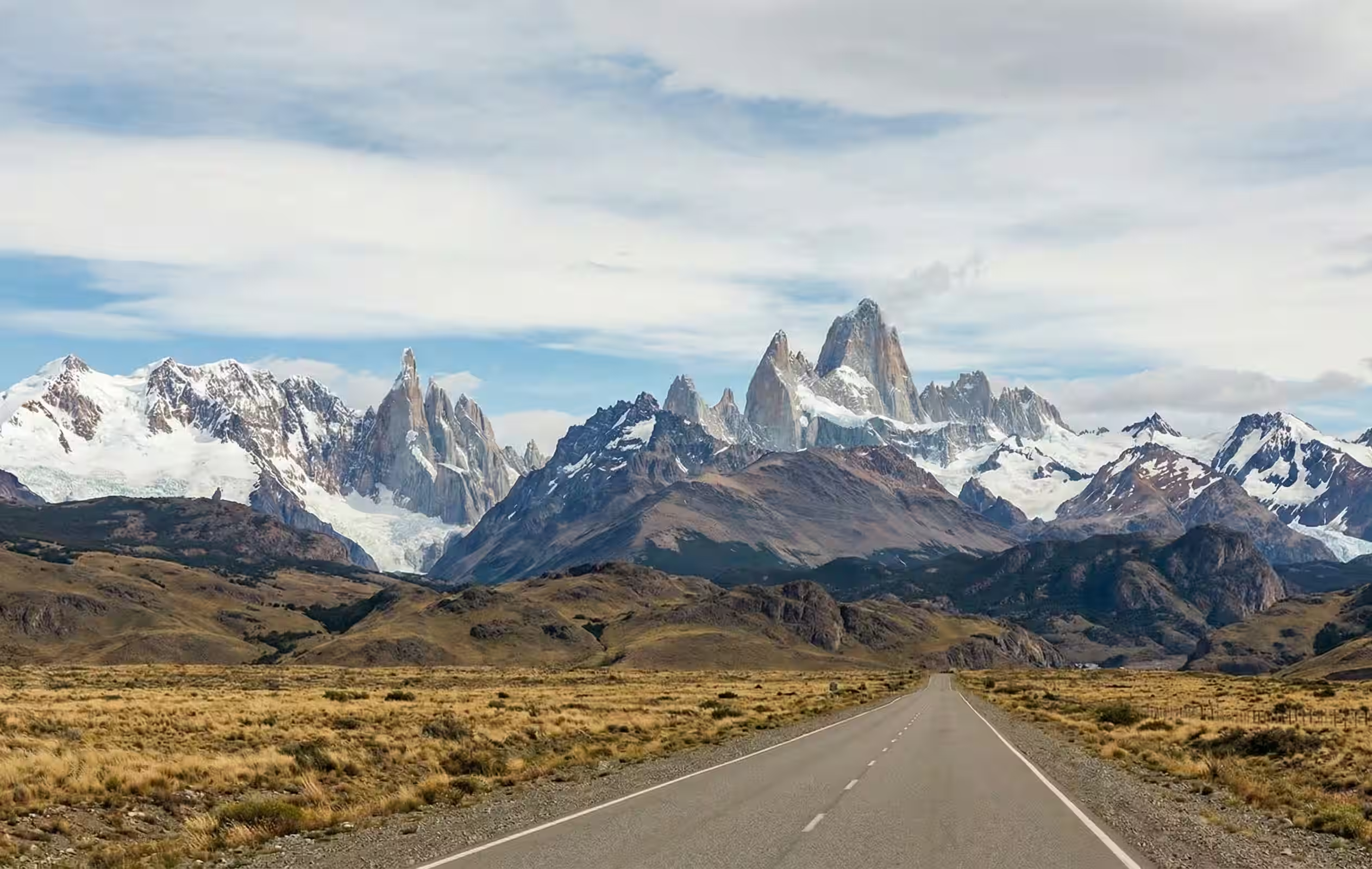
Accommodation for lithium projects in the Argentine Puna faces conditions with no parallel in conventional Andean mining. The combination of extreme altitude (3,500 to 4,500 meters above sea level), temperatures swinging between -20°C at night and +25°C at midday, and winds exceeding 100 km/h for consecutive days, tests any modular infrastructure solution that was not specifically designed for that environment.
The accelerated expansion of lithium projects in Salta, Jujuy and Catamarca forces this challenge to be solved at scale. The active and under-construction projects of the lithium triangle —Cauchari-Olaroz, Rincón, Mariana, Olaroz, Tres Quebradas, Sal de Vida— require camps that operate continuously for months or years under conditions that standard infrastructure was not designed to withstand.
The Puna's specific challenges for accommodation
Altitude and oxygen: the invisible factor
The lithium triangle's salt flats sit between 3,500 and 4,200 m.a.s.l. At those heights, atmospheric pressure is 35–40% lower than at sea level, which means less oxygen available per volume of air. Sustained physical work requires formal acclimatization periods, and nighttime rest becomes more critical for staff recovery.
Accommodation modules must be airtight: a cold infiltration during the night —caused by a degraded seal, a panel with insufficient insulation or a seal that failed under thermal contraction— can directly compromise sleep quality and the next day's performance. At altitude, that impact is amplified.
Daily thermal swing of 40°C
The Puna has one of the most extreme daily thermal swings on the planet. In summer it is common to record -15°C at 5 AM and +25°C at midday. In winter, nighttime lows can drop to -20°C or less.
The module's insulation must work in both directions: retain heat at night so the heating system does not run continuously, and not become an oven at midday, when solar radiation at that altitude is intense.
Insulation materials that expand and contract with thermal cycles lose insulating capacity over time. Joints and seals not designed for those cycles degrade in months.
Wind: gusts up to 130 km/h
Wind in the Puna is no minor factor. Wind waves can sustain speeds of 100–130 km/h for two or three consecutive days. Modules without wind-resistance certification can lose lateral sealing, generate dust and cold infiltration, or —in extreme cases— shift if they are not correctly anchored.
Certified resistance to wind level 11 (100–120 km/h) is not an optional specification in the Puna: it is the minimum threshold to guarantee the module's integrity during the area's normal weather conditions.
Why rock wool is the only valid option in the Puna
Insulation is the most critical component for habitability in the Puna. And here the difference between rock wool and EPS (expanded polystyrene) is not one of grade: it is one of category.
Rock wool: Class A fireproof
Rock wool is a non-combustible mineral material that does not propagate fire. In Puna camps, where generators, heaters and power cables work in cold, windy environments, Class A fireproofing is not a bonus: it is a safety requirement.
The main operators of the lithium triangle —Lithium Americas / Ganfeng, Allkem, Rio Tinto Rincon, Zijin— require in their contract specifications that accommodation modules have Class A insulation. EPS does not meet that requirement.
Thermal stability under extreme cycles
Rock wool does not appreciably expand or contract with temperature changes. Unlike EPS, which undergoes expansion and contraction cycles that degrade its insulating capacity over time, rock wool maintains its performance throughout the module's useful life.
In the Puna, with daily thermal swings of 40°C and several hundred cycles a year, this characteristic is decisive for the module's durability.
Low moisture absorption
Nighttime mist and condensation on exterior walls are frequent in the Puna salt flats. An insulation material that absorbs moisture loses insulating capacity in a few weeks. Rock wool has low hygroscopicity: it maintains its properties in humid environments.
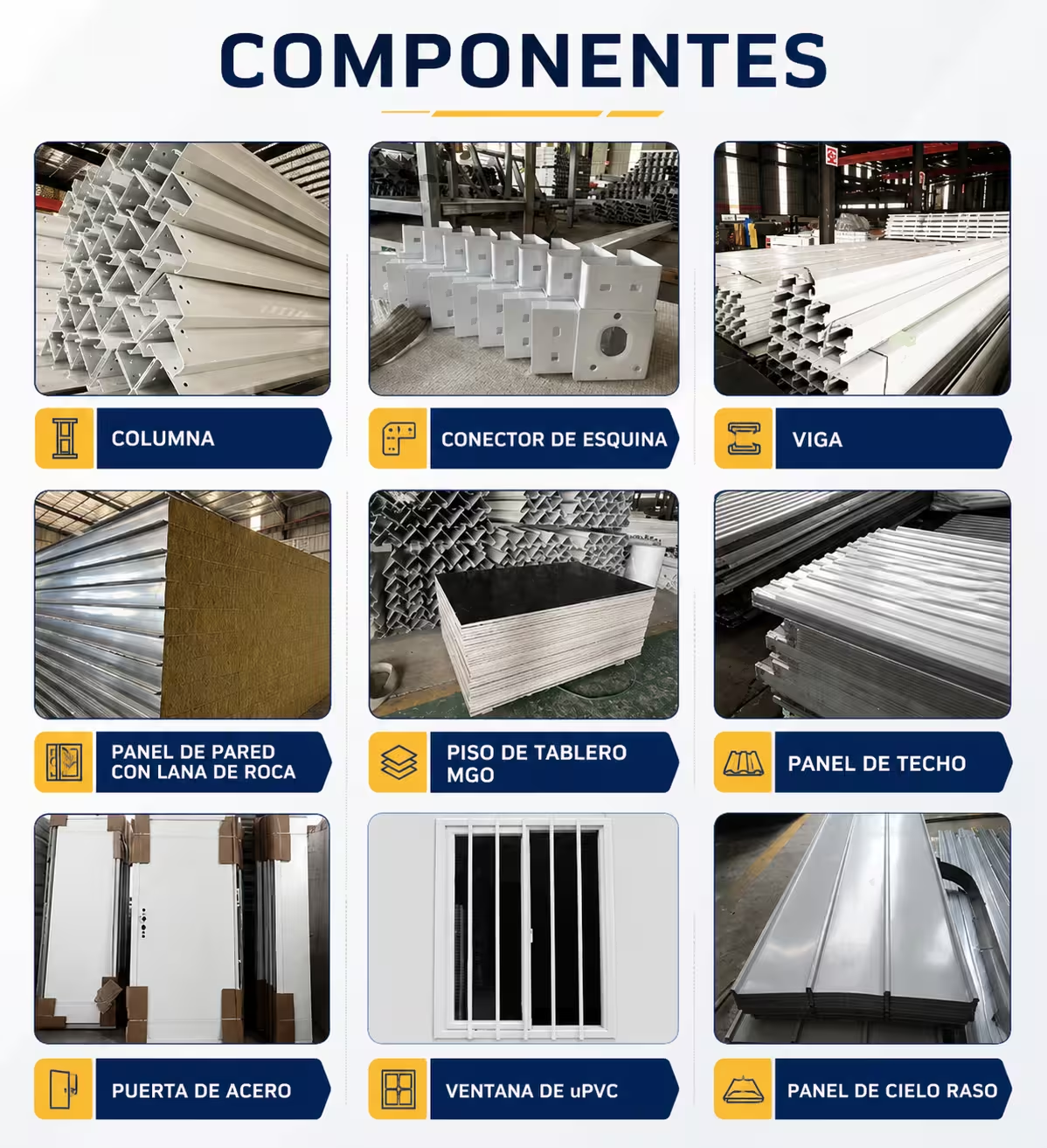
The folding modules we manufacture use 50 mm rock wool with a density of 65 kg/m³, Class A fire resistance. The roof carries 60 kg/m³ rock wool. They are validated for wind level 11 and seismic grade 10, the two most demanding conditions of the Puna environment.
Logistics in the Puna: access windows and folding modules
The lithium triangle's salt flats have an additional logistical problem to high-Andean mining: access roads may be passable only at certain times of year. Summer rains (January-March in the NOA) turn dirt roads over clay or saline soil into mud impassable for heavy vehicles.
This forces module movement to be planned in specific windows of the year, usually between May and December. And it makes logistical efficiency more critical: there is no margin for multiple trips in periods of restricted access.
A standard folding module, in transport position, measures 5,800 × 2,500 × 360 mm and weighs 1,100 kg. Twelve of those modules travel in a 40-foot container. That means a 24-module camp requires 2 trips, not 24.
In a 6-week access window, the difference between 2 trips and 24 can be the difference between being able to assemble the complete camp before the seasonal closure or having to wait another year to finish the installation.
Labor habitability regulations in high-altitude camps
SRT Resolution 905/2015 sets minimum work and habitability requirements for camps in remote areas. Operators with international capital additionally apply their own corporate HSE standards, frequently more demanding than the national regulations.
Among the usual requirements:
- Guaranteed minimum indoor temperature of 18°C during rest periods
- Controlled ventilation with sufficient air renewal
- Physical separation of sanitary and housing modules
- Independent electrical circuits for heating systems
- Certification of construction materials by recognized bodies (CE, ISO)
Folding modules with CE certification meet these standards and simplify the operator's process of approving the accommodation conditions.
The lithium triangle projects and their accommodation needs
The main active and developing projects in the NOA concentrate the largest high-altitude accommodation demand in Argentina:
Salta: Cauchari-Olaroz (Lithium Americas / Ganfeng, approx. 3,900 m.a.s.l.), Rincón (Rio Tinto Rincon, 3,700 m.a.s.l.), Mariana (Lithium Chile, 4,000 m.a.s.l.).
Jujuy: Olaroz (Allkem / Toyota Tsusho, 3,900 m.a.s.l.), Pozuelos (in exploration).
Catamarca: Tres Quebradas (Zijin / Neo Lithium, 4,200 m.a.s.l.), Sal de Vida (Allkem, 3,900 m.a.s.l.), MARA (Glencore / Pan American Silver, 4,000 m.a.s.l.).
For projects in these areas, the starting logistics base is usually Salta city, San Antonio de los Cobres (Salta) or Antofagasta de la Sierra (Catamarca). The distance and road condition determine the number of possible trips in an access window.
Rutas del Sur supplies folding housing modules for operations in the Salta and Jujuy area and in Catamarca. The lithium zone page details the complete coverage of the triangle. The CE-certified folding modules are validated for the altitude, cold and wind conditions that characterize the NOA salt flats.
How to plan accommodation for your lithium project
The data that determine the camp configuration:
- Number of people and shift rotation (how many people sleep simultaneously?)
- Project duration and the possibility of phased expansion
- Access window to the site for module delivery
- Operator requirements regarding HSE and certifications
- Exact altitude and site weather conditions (to adjust anchoring specifications)
With that information, the camp sizing and the quote are completed in less than 24 business hours.
To inquire about accommodation options for your lithium project in the NOA, message us on WhatsApp or request a quote. We reply with price, timeline and availability within 24 business hours.