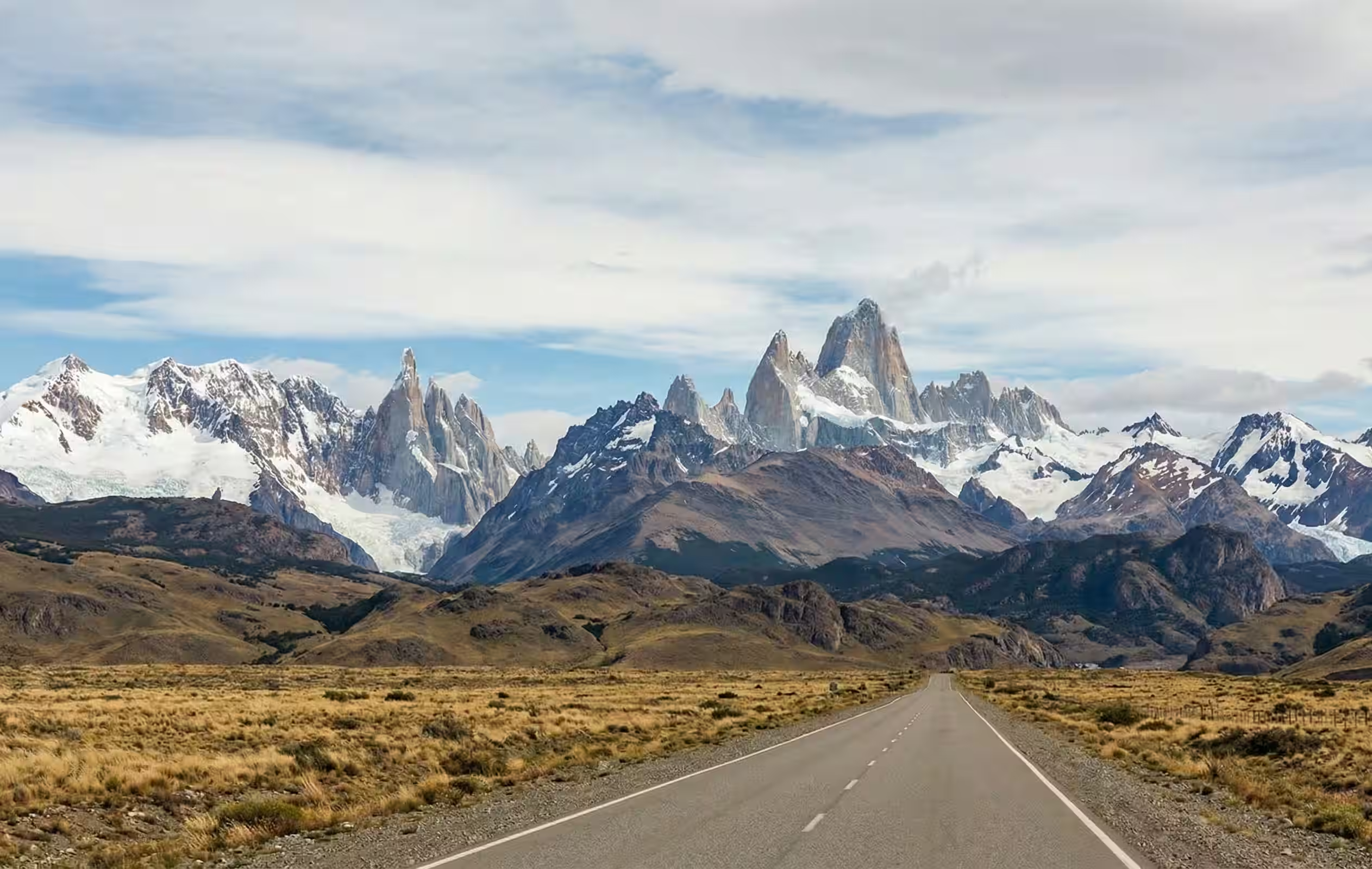
Cristo Redentor Pass: Complete Guide for Carriers
Everything you need to know to cross the Cristo Redentor Pass with cargo: documentation, hours, snow closures and customs procedures.
The Cristo Redentor International Pass —also known as Los Libertadores Pass or Cristo Redentor Tunnel— is the highest-traffic heavy-cargo crossing between Argentina and Chile. At 3,832 meters above sea level, it connects Mendoza with Santiago de Chile via National Route 7 and Chilean Route 60, crossing the Andes at its most accessible point for overland cargo transport.
For any company operating on the Mendoza–Chile corridor, knowing in detail the operating conditions, the required documentation and the opening and closing dynamics is not a nice-to-have: it is a basic operational requirement that determines cargo planning, the transit times promised to the client and the contingency for unexpected weather.
This guide gathers everything you need to know.
Where it is and why it concentrates so much traffic
The Cristo Redentor Pass is located 193 km from Mendoza city via National Route 7. The Cristo Redentor International Tunnel, 3.1 km long, was inaugurated in 1980 and operates 24 hours during the open period. Before the tunnel, the crossing was done over the mountain route (currently only open to light vehicles in summer).
The pass concentrates between 60 and 70% of overland cargo traffic between Argentina and Chile. Through here pass agro-industrial exports from Cuyo (wine, oil, fruit), minerals from San Juan and Catamarca, industrial products from the center of the country and import cargo to the Argentine interior. It is also the central overland link of the Bioceanic Corridor connecting the Atlantic ports with the Pacific ones.
For cargo originating in Mendoza, San Juan, Cuyo or Neuquén, this pass is almost always the shortest and most efficient route to Chile: the alternative via Buenos Aires means an extra 500 to 1,200 km depending on the cargo origin.
Opening and closing of the Cristo Redentor Pass: the annual cycle
The pass's sensitivity to Andean snowfall is the factor that most impacts operational planning.
Normal open period
From October to April, the pass operates normally 24 hours. In January and February —peak season for fresh-fruit and wine exports— it is common to find waiting lines of 2 to 4 hours at the controls.
Period of greatest closure risk: May to September
July is historically the month with the most closure days. Closures are triggered by active snowfall over the corridor or by weather forecasts that justify them preventively.
Preventive nighttime closures in winter are frequent: the National Gendarmerie can close the pass starting at 6 or 8 PM given negative forecasts, even without active snowfall at the time of closure.
Typical duration of a closure
- Minor closure (moderate snowfall): 12 to 24 hours
- Extended closure (intense weather event): 48 to 72 hours
- Exceptional events (La Niña seasons): up to 5 continuous days
After a closure, the reopening generates accumulated queues that can extend the crossing time by an additional 6 to 12 hours over the normal time.
The Cristo Redentor Pass status page gathers the official sources and the operational information relevant to carriers who work the corridor regularly.
Documentation required to cross with cargo
Documentation varies according to the type of cargo and whether it is export, import or transit. These are the base documents for general cargo:
MIC/DTA — the central document
The International Cargo Manifest / Customs Transit Declaration is the main document for international overland transport between Argentina and Chile. It is processed before the customs office of origin (Mendoza Customs) and must be handled by an authorized customs broker. The carrier must have a valid CNRT authorization for international transport.
Packing List and Commercial Invoice
Detail of the goods with description, quantity, weight and FOB value. They are the fundamental documents for customs control in both countries. Any inconsistency between the packing list and the actual goods causes delays at Chilean customs and may lead to a physical inspection.
Phytosanitary Certificate
Mandatory for cargo of plant origin, agricultural products, wood and derivatives. Issued by SENASA (Argentina) when the origin is Argentine. It has a limited validity (usually 5 to 10 business days depending on the product) and must be valid at the time of crossing.
Certificate of Origin
Needed to access the tariff preferences of the ACE 35 Economic Complementation Agreement between Argentina and Chile. It is processed at Chambers of Commerce or before AFIP. It reduces tariffs at destination for the product categories included in the agreement.
ADR authorization for dangerous goods
For chemical, flammable, explosive products or other regulated categories. It requires a valid authorization for the carrier and the vehicle, specific documentation by substance class, certified ADR training for the driver and correctly installed identification plates on the vehicle.
Special permit for oversized cargo
Vehicles with cargo of exceptional dimensions or weight require prior authorization from National Highways (Vialidad Nacional) and the equivalent agency in Chile, with time restrictions and, in many cases, an escort. The procedures must be started several days in advance.
The crossing process: Argentine and Chilean customs
Crossing the Cristo Redentor Pass has two separate customs stages:
Argentine Customs (Mendoza Customs / Los Libertadores Complex)
Exit control. The MIC/DTA documentation is verified, weighing is done if applicable, and the exit documentation is stamped. Time at Argentine customs is usually 30 to 90 minutes under normal conditions.
Chilean Customs (Los Andes Customs)
Entry control. It is the stage that most frequently generates delays. It includes a detailed review of documentation, and may involve a physical inspection of the cargo via scanner or manual review. In periods of high demand or sanitary alerts, times can extend to 3–5 hours.
Incorrect documents or inconsistencies between the declaration and the actual cargo force corrections to be processed that can take hours or, in complex cases, days.
Real Mendoza–Santiago transit times
| Condition | Total time |
|---|---|
| No delays (low season) | 6–7 hours |
| With normal customs line | 8–10 hours |
| With physical inspection in Chile | 10–14 hours |
| Reopening after closure (accumulated queue) | 14–24 hours |
| Active closure | Indeterminate time |
The prudent operational practice in winter is to plan with a 50% margin over the estimated time and always communicate a range to the client instead of an exact delivery time.
Operational tips for corridor carriers
- Check the status before leaving Mendoza: the status can change in a few hours. Arriving at the foot of the mountain with the pass closed means an unrecoverable wait.
- Leave early on winter days: on winter open days, leaving before 6 AM maximizes the chances of completing the crossing before weather conditions worsen.
- Complete and reviewed documentation before starting the trip: an error in the MIC/DTA forces a return to Mendoza to correct it.
- Check the validity of phytosanitary certificates: many are valid for 5 business days. An expired certificate at Chilean customs stops the cargo.
- Report position periodically: changes in the state of the pass can trigger detour or return procedures that require real-time coordination.
The Bioceanic Corridor and the Cristo Redentor Pass
The Cristo Redentor Pass is the central overland link of the Bioceanic Corridor connecting the Atlantic ports with the Pacific ones. The growth of Argentine foreign trade with Asian markets —the main destination for minerals, food and energy— makes the annual cargo volume through this pass grow steadily.
For cargo originating in the Argentine interior (Cuyo, San Juan, Neuquén) or destined for Pacific markets, the Mendoza–Valparaíso / Mendoza–San Antonio corridor is up to 30% more efficient than the Atlantic alternative via Buenos Aires.
Rutas del Sur's transport to Chile and international Argentina–Chile transport services operate this corridor with their own fleet and over 40 years of experience on the crossing.
Alternatives when the pass is closed
Pehuenche Pass (National Route 145, Malargüe)
It is the main alternative for heavy cargo when Cristo Redentor closes. The route leaves Malargüe (south of Mendoza), crosses the Pehuenche Pass (2,533 m.a.s.l.) and reaches Talca in Chile. It is about 200 km longer than the route via Cristo Redentor, but it operates under more stable weather conditions during winter.
Limitations: some types of special or large-volume cargo may have restrictions through Pehuenche. Check before redirecting.
Agua Negra Pass (San Juan)
It operates only in summer (November to April). It connects San Juan (Calingasta) with La Serena in Chile. It is not an alternative for the Mendoza–Santiago corridor.
Cardenal Samoré Pass (Neuquén)
For cargo from Neuquén toward the Chilean Lake District. It does not cover the same commercial corridor as Cristo Redentor.
Frequently asked questions about the Cristo Redentor Pass
When does the Cristo Redentor Pass close? The period of greatest risk is between May and September. July historically concentrates the highest number of closures due to heavy snowfall over the Andes.
What documentation is needed to cross with general cargo? MIC/DTA, packing list, commercial invoice and phytosanitary certificates if the cargo is of plant origin. For dangerous goods: active ADR authorization.
How long does the full Mendoza–Santiago crossing take? Between 6 and 12 hours depending on the state of the pass, the number of vehicles in line and customs time. In peak season it can extend to 18 hours.
What alternative is there when the pass is closed? The Pehuenche Pass via Route 145 from Malargüe is the main alternative for heavy cargo. It is 200 km longer but has more stable weather conditions in winter.
We operate the Mendoza–Chile corridor with our own fleet and over 40 years of experience. To quote your international transport, contact us or message us on WhatsApp.