Housing Modules for Farms and Estates: Options and Costs in Argentina
How to use folding housing modules on rural establishments, estates and farms in Argentina. Use cases, costs and advantages over conventional construction.
The problem of rural establishments
A farm or estate in Argentina usually has the same need: habitable space in a place where building is expensive, difficult or simply makes no economic sense given the project's timeframe.
Folding housing modules solve that problem. They are not the only solution, but in many cases they are the fastest, cheapest and most flexible.
Frequent uses on farms and estates
Housing for temporary staff
The fruit harvest, grape harvest, shearing or any seasonal activity brings in outside staff for weeks or months. A camp of 4–8 modules can house that crew with dignity, without building anything permanent.
At the end of the season, the modules are cleaned and stored (or relocated to another estate for the next harvest).
Administration office on the farm
For larger-scale estates that require the presence of agronomists, veterinarians, supervisors or administration, an 18 m² module works as an operational office with electricity, lighting and climate control. With no need to build a shed or remodel existing facilities.
Housing for the owner or manager
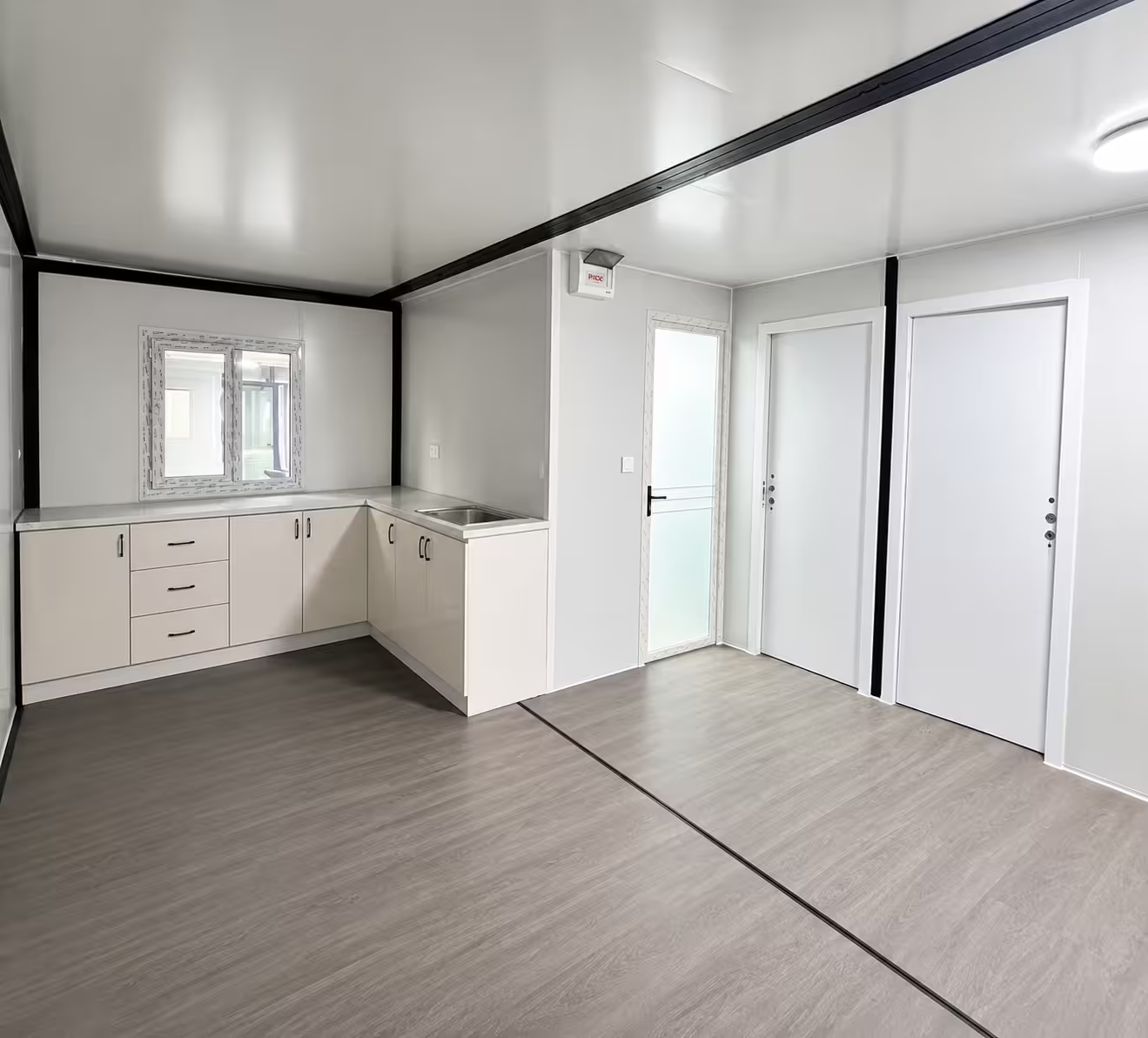
On an establishment with stable staff, the manager needs housing on the property. A basic folding module or an expandable one with an integrated kitchen and bathroom can be the cheapest and fastest solution compared to conventional construction.
Health or veterinary post
On a livestock farm or estates with numerous staff, a module can be designated as a first-aid infirmary or consulting rooms for veterinarians. With basic equipment, the module is functional the same day of installation.
Agricultural-input storage
A closed module with good thermal insulation is useful for storing phytosanitary products, seeds, lubricants or other temperature-sensitive inputs. The metal structure resists rodents and the space can be organized with shelving.
Why the folding module has an advantage in rural areas
It needs no civil works
The biggest barrier to building in the countryside is the cost of foundations. A cesspit, a slab or a septic system on a property without infrastructure can cost as much as the module itself. The folding module sits on a leveled base —metal profiles or concrete blocks— without excavating or building.
It arrives by truck, with no crew
A folding module is delivered on a standard truck. You do not need to hire builders, masons or civil engineers. Two people with the basic instructions deploy it in 15 minutes.
In remote areas of Mendoza, San Juan, Neuquén or northern Argentina, where getting a construction crew is expensive and takes time, that advantage is decisive.
It can be relocated
If the estate changes use, if the project ends or if you need the module elsewhere on the property, it folds and moves. There is nothing to demolish or debris to manage.
It withstands country conditions
Folding modules have a Q235B steel structure, Class A rock-wool insulation and CE certification. They are validated for wind level 11 and seismic grade 10. In areas with Zonda wind, hail, frost or extreme thermal swings (like the Mendoza dryland or the Puna), those features are decisive.
Guideline costs for rural uses
| Configuration | Modules | Estimated cost |
|---|---|---|
| Housing for 4 people (2 dormitories) | 2 folding modules | Request a quote |
| Office + staff dining hall | 2 modules | Request a quote |
| Camp for 10 people (dorm + bathroom + dining) | 4–5 modules | Request a quote |
| Housing with integrated bathroom (expandable 34.6 m²) | 1 expandable module | Request a quote |
To get updated prices, request a quote with the quantity and location of the project.
Freight to the farm: how much it costs and how it works
The delivery cost depends on the distance from the base (Mendoza) and the accessibility of the road. For farms with a dirt access in good condition and a reasonable distance, the freight cost is split among all the modules in the order.
If you order 6 modules in a single trip, the freight is the same as if you ordered 1. The advantage of the folding module is that 6 units fit on a truck: the cost per module is diluted.
For farms without access for a large truck, we can coordinate delivery on a smaller truck or at transfer points near the destination.
Frequently asked questions about rural use
Do I need a permit to install a module on my farm? In general, folding modules are considered temporary structures and have lower permit requirements than permanent constructions. It varies by municipality and province. For internal use of the establishment, in most rural areas no municipal authorization is required.
Can I connect the module to the rural electrical grid? Yes. The module has a panel and interior wiring ready to connect to the grid. If the property has no electricity, it is compatible with a generator or a solar photovoltaic system.
How long does the module last in country conditions? The estimated useful life is 15–20 years with basic maintenance (cleaning, seal inspection and painting every 3–5 years). The galvanized-steel structure requires no special maintenance.
Does the module withstand hail and wind? Yes. It is designed for winds up to 110 km/h and hail-impact resistance. In areas with extreme conditions (gales, storms), it is advisable to ask about the ground-anchoring system.
If you want to explore options for your farm or estate, you can see the folding module technical sheet or the expandable module one, which offers 34.6 m² of usable surface and is ideal for housing with greater comfort.
For inquiries and quotes with delivery throughout Argentina, message us directly on WhatsApp.