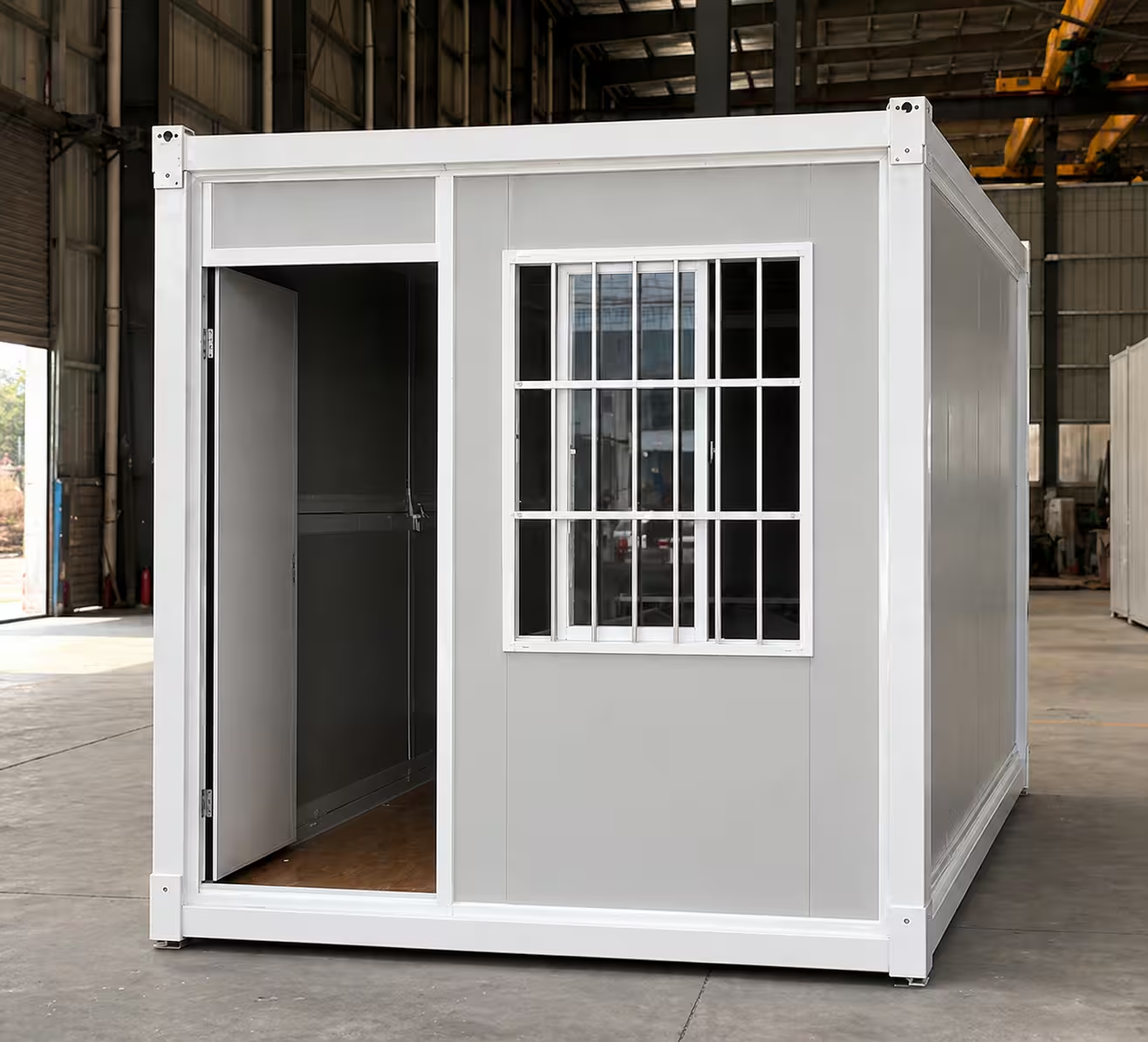
Habitable Container vs. New Module: Which Is Worth It in Argentina (2026)
Technical and cost comparison between adapted recycled maritime containers and new CE-certified housing modules. Which is worth it depending on the use.
The question many people ask
When someone looks for a temporary housing solution —for a construction site, a camp, a farm or a mining site— they usually arrive at two seemingly similar options: the habitable container and the new housing module.
The container seems cheaper. The module seems more expensive. But the quick comparison by initial price is misleading. This article breaks down the real differences between the two options.
What each one is
Habitable container (recycled ISO)
A habitable container is a 20- or 40-foot ISO container —originally designed for maritime cargo transport— that was retired from the commercial fleet and adapted for residential use. The process involves cleaning the interior, adding insulation, installing electricity, laying flooring and adding carpentry.
The key point many ignore: it was designed to transport goods, not to be lived in.
New housing module (folding or expandable)
A new housing module is a structure designed from the ground up to be habitable. It is built with a Q235B steel structure and a 50 mm rock-wool panel (65 kg/m³, Class A fire resistance), with integrated thermal and acoustic insulation, an included electrical system, vinyl flooring and CE certification.
In the folding version, the module collapses for transport (up to 12 units in a 40-foot container, 1,100 kg/unit) and deploys in 15 minutes at destination.
Technical comparison
| Feature | New module (CE) | Recycled ISO container |
|---|---|---|
| Certification | CE · SGS · ISO 9001 | None — naval structure |
| Thermal insulation | 50 mm / 65 kg/m³ Class A rock wool included | Not included — added afterward |
| Acoustic insulation | Included as standard | Not included |
| Toxicity | No lead paints | Toxic anti-corrosion paints |
| Designed to be lived in | Yes | No — adapted after maritime use |
| Units per truck | Up to 12 (folding) | 1 |
| Installation | 15 min — 2 people | 4–8 hrs — specialized crew |
| Warranty | Factory technical documentation | None |
| Estimated useful life | 15–20 years | Variable — depends on condition |
The toxic-paint problem
This is the point least mentioned when evaluating a container for residential use.
ISO containers use anti-corrosion paints with lead and hexavalent chromate —highly toxic compounds— to protect the structure from the marine environment. They are industrial paints designed for surfaces that will never be in contact with people.
To make a second-hand container habitable, those paints must be removed correctly. That process requires:
- Specific protective equipment for workers
- Hazardous-waste handling
- Final disposal in compliance with regulations
- An additional cost of USD 800–2,000 per container
Simply painting over is not a solution. The old paints keep emitting compounds in closed environments with heat.
The insulation problem
A pure steel container has very high thermal conductivity. Without insulation, in summer the interior can exceed 50°C and in winter the conditions are uninhabitable in cold areas.
Insulation can be added after purchase, but it has a real cost:
- Glass wool or EPS: USD 1,500–3,500 per container
- Interior lining panels: USD 500–1,500
- Labor: USD 800–1,500
Total for insulation alone: USD 2,800–6,500 extra.
The logistics problem
An ISO container weighs between 2,200 and 3,800 kg empty, has a rigid structure and can only be transported in a horizontal position. That means one truck per container.
To set up a 10-module camp: 10 trips.
At a Puna site at 4,000 meters, with restricted access and a mountain route, that is weeks of logistics and a cost that easily exceeds that of the modules themselves.
A new folding module, on the other hand, transports up to 12 units on a standard truck. The same 10-module camp: 1 trip.
Real total cost compared
| Item | Recycled container | New folding module |
|---|---|---|
| Initial price | USD 2,500–4,000 | USD 6,500 |
| Paint decontamination | USD 800–2,000 | USD 0 |
| Insulation | USD 2,800–6,500 | USD 0 (included) |
| Extra electrical system | USD 500–1,500 | USD 0 (included) |
| Freight (1 unit) | Truck price × 10 | Truck price / 12 |
| Residential certification | Not available | CE · ISO 9001 · SGS |
| Total cost | Significantly higher than the initial price | Quote by project and quantity |
The initial-price difference disappears —or reverses— when the total cost is considered.
When can a recycled container make sense?
There are cases where an ISO container makes sense:
- Tool or material storage (non-residential): it does not require insulation or decontamination, since no people are inside for prolonged periods.
- Permanent fixed structure: if the project is long, the container will stay in place forever and the remodeling cost amortizes over many years of use.
- Very tight budget constraints with available time: if you have time and remodeling capacity, you can get a cheap container and fit it out gradually.
For temporary camps, mining, construction or uses where the module needs to be relocated, the new module is always the most rational option from an economic and technical standpoint.
What to check before deciding
If you evaluate a habitable container, ask:
- Does it have paint-decontamination documentation? Who performed it?
- What type of insulation does it have and when was it installed?
- Does it have residential certification or is it just an artisanal adaptation?
- How many trips do you need to move it when the project ends?
If the answer to any of these questions is "no" or "I don't know", the real cost of the container is higher than what appears on the list price.
If you are evaluating options for your camp, construction site or project, you can check our folding housing modules line or compare both options in detail.