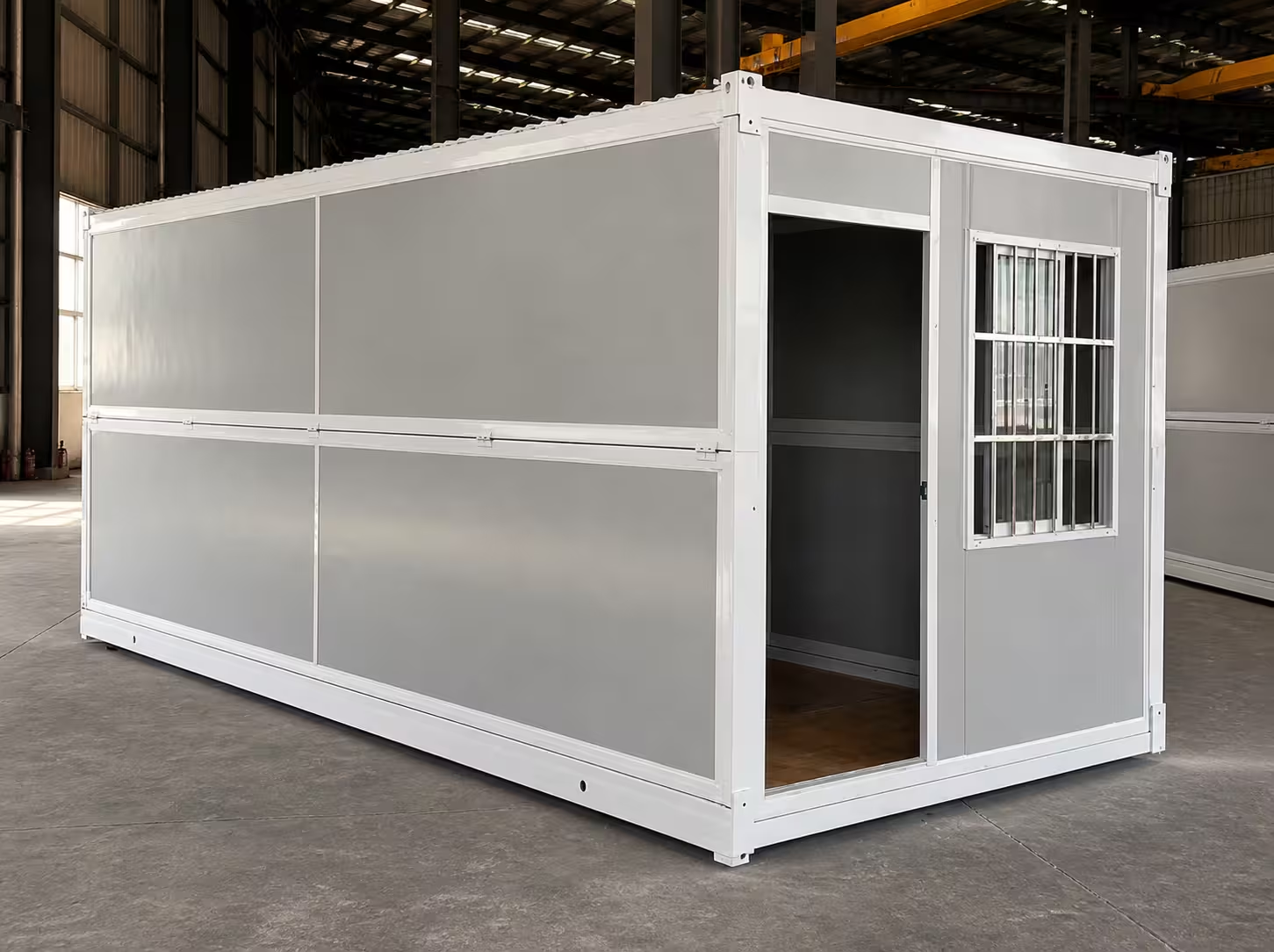
Modular vs. Traditional Construction: Costs and Times in Argentina 2026
A real comparison between modular and traditional construction in Argentina: costs, times, advantages and when each is worth it. Analysis with real data.
When comparing modular vs. traditional construction, the discussion usually stays on the module's initial price. That comparison is incomplete: the real cost includes construction time, labor, civil works, logistics, permits and the opportunity cost of every week that passes before the structure is operational.
In Argentina, where material prices vary month to month, construction suppliers are hard to coordinate in interior areas and access to many destinations is limited, modular construction has advantages that do not appear in the price-per-square-meter comparison.
This article breaks down the comparison with real data, without simplifications.
Comparison table: modular vs. traditional at a glance
| Aspect | Modular construction | Traditional construction |
|---|---|---|
| Time to habitable | 1 to 2 days | 4 to 8 months |
| Prior civil works | Not required | Mandatory foundations |
| Personnel needed | 2 people + crane | Crew + specialists |
| Relocatable | Yes | No |
| Units per truck | Up to 12 (folding module) | Not applicable |
| Certifications | CE / ISO 9001 / SGS | Variable by builder |
| Certified seismic resistance | Grade 10 | Per structural calculation |
| Useful life | 15–20 years | 30–50 years |
| Permits in rural areas | Lower (temporary structure) | Plans + permits + final inspection |
Modular vs. traditional construction times: from 4 to 8 months to one day
This is the most impactful figure when seen for the first time: a folding housing module deploys in 15 minutes. The electrical connections and final leveling take an additional day, two at most.
A traditional construction with the same square meters takes between 4 and 8 months, depending on access to materials, crew availability and weather conditions. In interior areas —San Juan, Neuquén, northern Argentina— times stretch because suppliers are scarce and inputs arrive with variable delays.
For a mining, oil & gas, tourism or farm project that needs working infrastructure in weeks, the difference is no small matter: it is the difference between operating and not operating.
Costs: initial price vs. total system cost
The folding module may seem expensive if you compare the price per square meter with that of a construction in an urban area with available materials. That comparison ignores the total system cost.
The additional components rarely included in the initial budget of traditional construction are:
- Excavation and foundations: in remote areas, this item alone can cost more than the complete module
- Labor: crew coordination, delays and cost overruns are common in the sector
- Materials: in Argentina, prices rise during the construction period
- Logistics: bringing materials to a hard-to-access area is expensive and slow
- Time without operation: every week of delay has a direct cost on the project
With modular construction, the only significant item beyond the module price is the freight. And there the advantage of folding modules is decisive: up to 12 units travel on a standard truck. If the project needs 12 modules, the freight is 1 trip instead of 12.
Civil works: the invisible cost of traditional construction
The foundations requirement is the invisible barrier that few comparisons show. On any terrain that is not urban with services, building a solid base means a soil study, excavation, concrete and a minimum curing time of 28 days for structural concrete.
In remote areas, bringing the concrete mixer is difficult and expensive. In high mountains it can be outright impossible.
A folding or expandable module sits on metal profiles or precast concrete blocks, with no excavation. The site preparation time is measured in hours, not weeks.
Relocatability: the advantage rarely mentioned
A folding module is not just a dwelling: it is a reusable investment. When the project ends or needs change, the module folds, loads onto the truck and moves to the next site.
A traditional construction does not move. If the project ends or the use changes, a fixed structure remains that can be an asset or a liability depending on the context.
For construction camps, mining projects, temporary staff accommodation on farms or rural settings, or any use with an expiration date, the ability to relocate the module changes the economic analysis completely.
Permits and regulations
In rural areas and for temporary uses, folding and expandable modules are considered removable structures and have lower permit requirements than a permanent construction. The procedure varies by municipality and province, but in most cases it is simpler than that of a fixed building.
A traditional construction requires plans approved by the professional association, prior municipal authorization, progress inspections and a final inspection. In areas without a service network, the need to manage own solutions (well, cistern, generator) is added, each with its own permits.
Useful life and maintenance
The estimated useful life of a folding housing module is 15 to 20 years with basic maintenance: annual cleaning, seal inspection and exterior painting every 3 to 5 years. The hot-dip galvanized Q235B steel structure resists corrosion in dry environments.
A well-executed traditional construction can last 30 to 50 years or more, but in areas with extreme weather conditions —frost, severe thermal swings, earthquakes, hail— maintenance is more frequent and costly.
Environmental impact of modular vs. traditional construction
Modular construction has a significantly smaller footprint. There is no construction waste —cement, debris, leftover materials—, the soil is not permanently altered and no local construction services with their associated transport are required.
At the end of the use, the module is removed and the land remains practically in its original state. For projects in areas of high environmental value —ravines, wetlands, protected areas or high-altitude land— this point can be decisive for obtaining environmental permits.
When modular construction is worth it
Modular construction has a clear advantage in these scenarios:
- Remote areas without an available crew or materials: the module arrives assembled and ready
- Urgency of start-up: when you need to be operational in days, not months
- Temporary or relocatable projects: when the use has an expiration date
- Land without prior infrastructure: no foundations, no service network, no heavy-machinery access
- Certified extreme conditions: seismic Grade 10 and wind level 11 included from the factory
The 13.4 m² folding house is the most-used option for housing, staff accommodation and temporary uses. The 34.6 m² expandable house offers more surface with two bedrooms, a bathroom and an integrated kitchen. To choose between the two options, the folding vs. expandable comparison breaks down the key technical and logistical criteria.
When traditional construction is worth it
Traditional construction keeps an advantage in:
- Permanent, very long-term projects (more than 20–30 years on the same site)
- Large surface in a single unit (industrial dining halls, large workshops)
- Urban areas with good availability of materials and crews, where times are considerably reduced
- Aesthetic or integration requirements with existing architecture that the standard module cannot replicate
Frequently asked questions about modular construction
How long does the installation of a modular house take? Deploying a folding module takes 15 minutes with 2 people and a crane. The electrical connections and final leveling are completed in 1 or 2 additional days.
Does a modular house need foundations? No. It sits on leveled metal profiles or concrete blocks, with no excavation or wet works.
How many years does a modular house last? The estimated useful life is 15 to 20 years with basic maintenance: cleaning and painting every 3 to 5 years.
Can a modular house be relocated? Yes. A folding module collapses in minutes, loads onto the truck and is taken to another destination with no demolition or debris.
To inquire about folding and expandable housing module options with delivery throughout the country, contact us on WhatsApp or request a quote.